India has taken a significant step forward in urban sanitation with the launch of the Swachh Shehar Jodi (SSJ) initiative. Unveiled by the Ministry of Housing and Urban Affairs (MoHUA), this ambitious program seeks to transform waste management and sanitation standards nationwide through a structured, city-to-city mentorship model.
What is the Swachh Shehar Jodi Initiative?
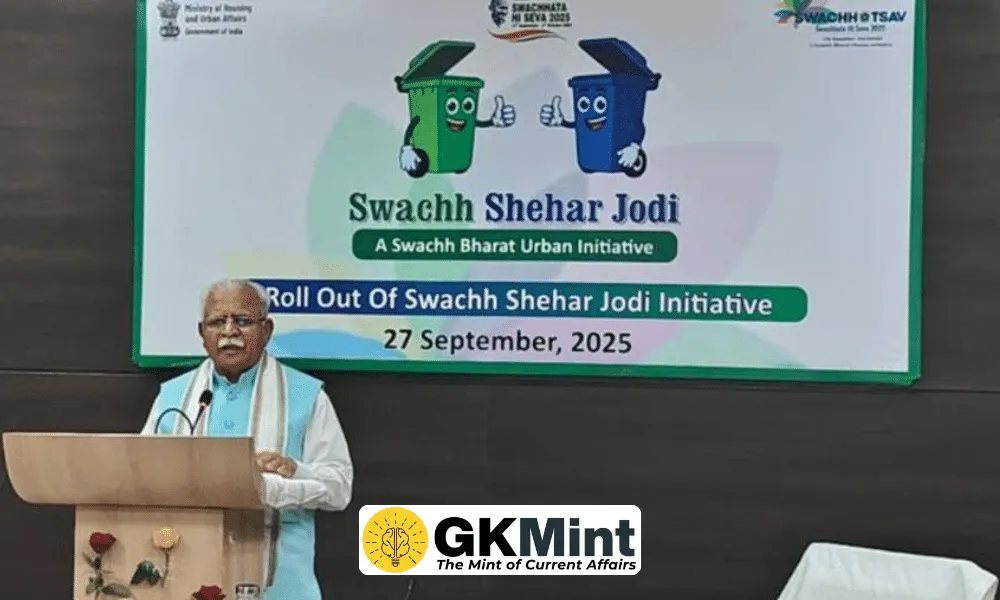
Launched on September 27, 2025, the Swachh Shehar Jodi is a large-scale urban waste management mentorship program under the Swachh Bharat Mission – Urban (SBM-U). The initiative pairs high-performing “mentor” cities with lower-performing “mentee” cities to encourage knowledge sharing, peer learning, and replication of best practices.
Currently, the program pairs 72 mentor cities with around 200 mentee cities. Housing and Urban Affairs Minister Manohar Lal Khattar described it as one of the largest structured, time-bound, and outcome-driven mentorship programs in the urban waste management sector. The initiative is inspired by the principle of Antyodaya, ensuring that no city is left behind and every urban area benefits from collective expertise.
How Does It Work?
The selection and pairing process is carefully designed using performance data from Swachh Survekshan, the world’s largest annual urban cleanliness survey.
Selection of Mentor Cities:
- High-achieving cities from the Super Swachh League (top performers from Swachh Survekshan 2022–2024)
- Top three cities in various population categories in Swachh Survekshan 2024
- Other “promising clean cities”
Selection of Mentee Cities:
- Cities ranking lowest in their state’s latest Swachh Survekshan cumulative rankings
- Geographical proximity to mentor cities to facilitate coordination
To formalize partnerships, nearly 300 Memorandums of Understanding (MoUs) were signed simultaneously nationwide, marking the official launch of the program.
The 100-Day Action Plan
A key feature of SSJ is an intensive 100-day action program, designed to demonstrate the immediate impact of mentorship. During this phase, mentor-mentee pairs will:
- Develop customized action plans with clear milestones
- Engage in experience sharing via workshops, training, and field visits
- Improve systems for waste segregation, collection, transport, and disposal
- Promote community participation and behavioral change
The Ministry will provide strategic direction, policy guidance, and operational support, while funding for capacity-building can be drawn from state and Union Territory allocations under SBM-U 2.0.
Key Focus Areas
The mentorship will focus on critical aspects of urban sanitation, including:
- Visible cleanliness of cities
- Waste segregation, transport, and scientific processing
- Access to sanitation and used water management
- Citizen advocacy and grievance redressal
Progress will be closely monitored, with the effectiveness of these partnerships evaluated in the Swachh Survekshan 2026 rankings, expected to show measurable improvements in mentee cities.
This initiative strengthens city-to-city collaboration, aligns with the broader goals of the Swachh Bharat Mission, and contributes to the UN Sustainable Development Goals, fostering healthier urban environments and improving the quality of life for citizens.
Correlation with UPSC Mains Syllabus
The Swachh Shehar Jodi (SSJ) initiative has direct relevance to multiple topics in the UPSC General Studies papers.
GS Paper 2: Governance, Constitution, Polity, Social Justice, and International Relations
- Government policies and interventions for development
Correlation: SSJ is a prime example of a government policy addressing developmental gaps in urban sanitation. It is a time-bound, outcome-driven mentorship program under SBM-U that pairs high-performing “mentor” cities with lower-performing “mentee” cities. Questions may focus on its innovative peer-learning approach, the signing of nearly 300 MoUs, and the 100-day action plan as a mechanism of implementation. - Important aspects of governance, transparency, and accountability
Correlation: SSJ promotes city-to-city collaboration and mutual accountability among Urban Local Bodies (ULBs). Pairing based on Swachh Survekshan rankings ensures a data-driven approach. Program evaluation in Swachh Survekshan 2026 provides accountability metrics. - Issues relating to social sector/services and health
Correlation: Urban sanitation and waste management are essential social services impacting public health. SSJ improves waste processing, access to sanitation, and overall cleanliness, aligning with the principle of Antyodaya and promoting inclusive development and social justice.
GS Paper 3: Technology, Economic Development, Biodiversity, Environment
- Conservation, environmental pollution, and degradation
Correlation: SSJ aims to improve municipal solid waste management in 200 cities, addressing urban pollution and land degradation. Focus areas include waste segregation, transport, and scientific processing, critical for environmental conservation. - Infrastructure
Correlation: Waste management infrastructure—including collection systems, processing plants, and sanitary landfills—is strengthened under SSJ. Mentee cities adopt best practices from mentor cities, with funding support from SBM-U 2.0 Capacity Building funds.
Correlation with TNPSC Group 1 Mains Syllabus
SSJ is also highly relevant for TNPSC Group 1 Mains.
Paper II: General Studies
- Unit I – Indian Polity and Emerging Political Trends
Correlation: SSJ demonstrates cooperative federalism at the local level, fostering inter-city partnerships to achieve national sanitation goals.
Paper III: General Studies
- Unit II – Environment, Biodiversity, and Disaster Management
Correlation: SSJ directly addresses urban pollution and solid waste management, offering a current case study of government action on environmental protection. - Unit III – Indian Economy and Current Economic Trends
Correlation: Urban development is crucial for the economy. SBM-U, under which SSJ operates, involves significant financial outlay. Effective waste management supports concepts like the circular economy, generating both economic and environmental benefits.
Paper IV: General Studies
- National and International Affairs
Correlation: Launched in 2025, SSJ is a significant national initiative. Its alignment with the Sustainable Development Goals (SDGs) gives it international relevance, and the model can serve as a blueprint for other countries.
Related Topics:
Swachh Bharat Mission:
The Swachh Bharat Mission (SBM) has been a landmark initiative in improving sanitation and waste management across India. Key highlights from the latest sources are summarized below:
- Urban Recognition: Swachh Survekshan 2024-25 Awards
- Cities such as Indore and Surat were recognized for excellence in cleanliness and sanitation.
- Introduction of the Swachh City Partnership initiative to promote peer mentorship and waste remediation between cities.
- Mission Structure and History
- Swachh Bharat Mission-Grameen (SBM-G): Focused on rural sanitation.
- Achieved significant reductions in diarrheal deaths.
- Generated economic benefits for communities through improved sanitation.
- Transformed rural hygiene practices and infrastructure.
- Swachh Survekshan: A competitive monitoring framework to drive urban sanitation.
- Encourages cities to adopt sustainable sanitation and waste management practices.
- Operates through public participation, data-driven evaluations, and annual rankings since 2014.
- Swachh Bharat Mission-Grameen (SBM-G): Focused on rural sanitation.
- Evolution of the Mission
- Initially aimed at eliminating open defecation.
- Expanded to encompass holistic waste management, including garbage segregation, recycling, and citizen engagement.
- Emphasizes performance metrics to ensure accountability and continuous improvement.
- Key Takeaways
- SBM showcases how government policy, public involvement, and competitive frameworks can transform sanitation outcomes.
- Integration of urban and rural programs ensures comprehensive national impact.
- Peer learning and recognition mechanisms encourage continuous innovation and excellence.
Quiz Based on Swachh Bharat Mission – Previous year Karnataka Civil Police Constable Paper
[ays_quiz id=’12’]
MindMap of Swachh Shehar Lodi
This mindmap visually organizes key concepts, highlighting the relationships between major components, processes, and outcomes. It emphasizes how different elements interact, showcasing cause-and-effect connections, underlying patterns, and practical applications. Designed for quick comprehension, it helps in reviewing, analyzing, and recalling information efficiently.
Mains Answer Writing Questions
The ‘Swachh Shehar Jodi’ initiative leverages peer learning and collaborative action as key tools for urban transformation. In this context, elaborate on the structure and objectives of the initiative. Discuss its potential significance in strengthening urban governance and achieving the goals of the Swachh Bharat Mission. (250 words)
Answer Outline
Introduction
- Define the Swachh Shehar Jodi (SSJ) initiative as a structured mentorship program launched under the Swachh Bharat Mission – Urban (SBM-U) by the Ministry of Housing and Urban Affairs (MoHUA).
- Core principle: pairing high-performing mentor cities with lower-performing mentee cities to foster knowledge sharing, peer learning, and replication of best practices in municipal solid waste management.
- Scale: involves 72 mentor cities and around 200 mentee cities, making it one of the largest structured mentorship frameworks in urban sanitation.
Body Part 1: Structure of the Initiative
- Selection and Pairing:
- Data-driven, based on Swachh Survekshan rankings.
- Mentor cities include top performers (“Super Swachh League”) and promising clean cities; mentee cities are lower-ranked, often geographically proximate to mentors.
- Implementation:
- Formalized via MoUs (around 300 signed nationwide).
- 100-day intensive program with customized action plans, workshops, training, field visits, and exposure to successful practices.
- Support and Evaluation:
- MoHUA provides strategic guidance; funding from Capacity Building (CB) funds under SBM-U 2.0.
- Effectiveness monitored via Swachh Survekshan 2026 rankings.
Body Part 2: Objectives
- Primary Objective: Facilitate knowledge and experience sharing to replicate tested practices from mentor to mentee cities.
- Specific Goals:
- Strengthen waste management processes and systems.
- Improve visible cleanliness, waste segregation, transport, and scientific processing.
- Enhance citizen engagement and behavioral change.
- Guiding Philosophy: Driven by Antyodaya, ensuring inclusive benefit for all cities.
Body Part 3: Significance
- Strengthening Urban Governance:
- Promotes collaboration over hierarchy.
- Encourages mutual learning, accountability, and capacity building among Urban Local Bodies.
- Achieving SBM Goals:
- Aligns with SBM and SDGs, contributing to healthier urban environments.
- Accelerates urban transformation via practical exposure to successful models.
- Potential blueprint for other sectors and international replication.
Conclusion
- SSJ is an innovative mentorship model addressing urban sanitation disparities.
- By leveraging the expertise of successful cities in a structured, time-bound, outcome-oriented manner, it can enhance governance, improve quality of life, and accelerate progress toward a truly ‘Swachh Bharat’.
Note:
You are required to attempt the following questions. Your answers will be evaluated within 24 hours, and feedback will be sent via email. Write answers in a structured format, highlighting key points, examples, and analysis.
Instructions:
- Write answers in 250–300 words.
- Structure your answers with Introduction, Key Points/Arguments, Examples, and Conclusion.
- Focus on analysis, evaluation, and clarity rather than just facts.
Upload your answers here:
- Maximum file size: 10 MB.
- Please convert scanned answer sheets to PDF before uploading.
- Write your Name, Email ID, and Mobile Number on your answer sheet for verification purposes.
- Failure to comply with the above rules will result in non-evaluation of your submission.
- Submitted answers will be evaluated and then deleted from our servers.
- Evaluated answer sheets will be sent only via email.