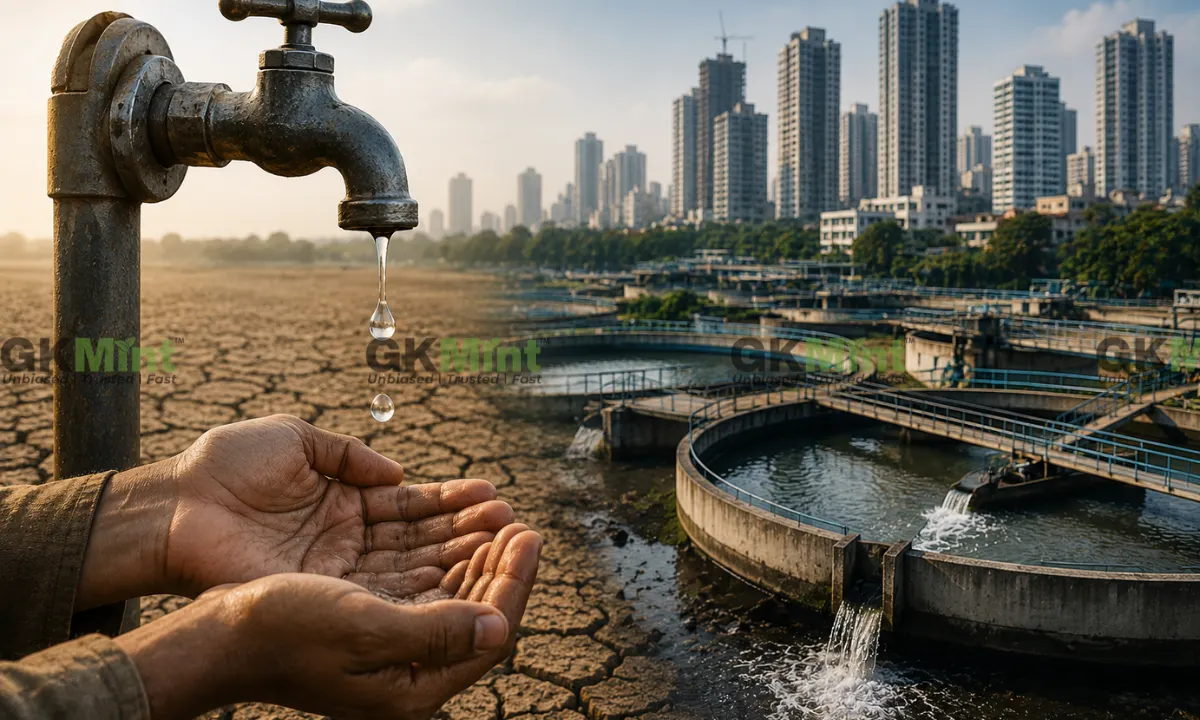
India’s Urban water services are likely inequitable and under-funded. This article argues that a focused reform agenda in a single political term can stablize them for good.
Background of the issue
Most of the cities loss 30% of water and treat only 27% of sewage. Utilities recover barely 55% of running costs from user changes. One single political term is enough to stabilise these services.
What is meant by Non – Revenue Water (NRW)?
Water that is produced but never billed to any consumer. This is mostly caused due to physical leak, meter errors and unbilled use. This happens in most large city utilities (about 30%). This leads to higher tarrifs, weaker service, wasted energy. These damages can be fixed by proper metering, leak repair and honest revenue collection.

The broader frame : Urban water governance
Water is a state subject and sanitation is a Municipal Function (74th Constitutional Amendment Act). Central missions like AMRUT & Jal jeevan Mission (Urban) fund taps and sewer networks. Now, the focus is primarily on new connections not on service pressure or quality. So going forward state grants can fill the gap year after year. Also, a clear state – city split of responsibility can unlock reform.
Major Structural Weaknesses Behind India Water Crisis
First and the primary reason is over reliance on distant rivers and groundwater. High losses due to water leaks, weak metering, unclear responsibility causes loss in efficiency in water transmission. Significant issue is the poor pay more per litre for less safe water, this hits hard on equitable sharing. Also, obsess over construction, ignoring O&M and climate.
Environment and Equity Concerns:
Most of the cities are draining shared groundwater faster than it can recharge. Also, piping distant water inflates pumping bills and carbon load. Most of the new reservoirs displace wetlands and worsen urban flooding. Most of the free tankers subsidise those already connected and not the poor.
Government’s response towards the India water crisis
Government needs to diversify mainstream rainwater harvesting and treated wastewater reuse. It also needs to use universal metering, implement bulk meters and worst – district leak drives.