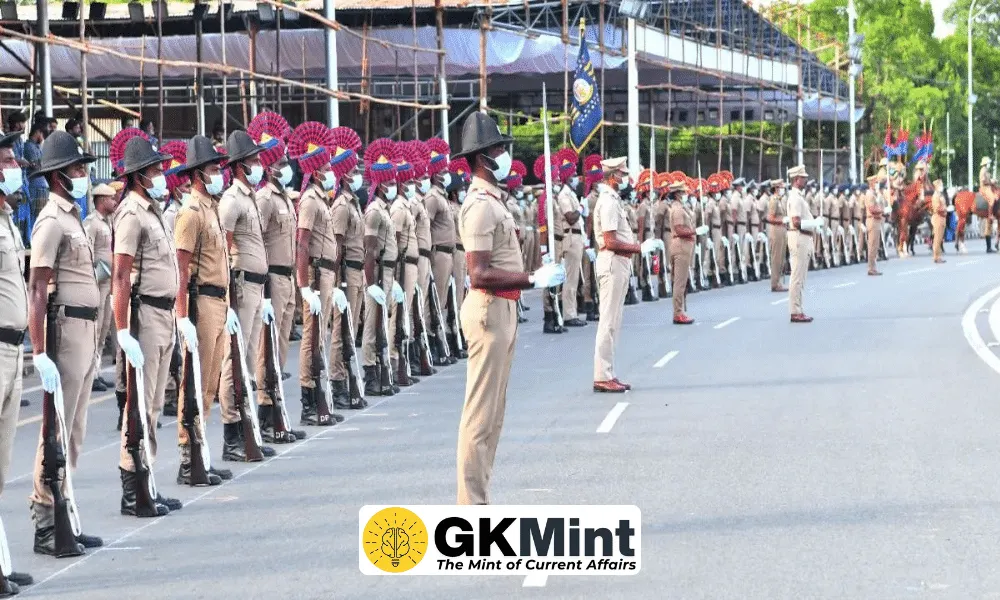
The Government of Tamil Nadu has recently issued a Government Order (G.O.) restricting the provision of Guard of Honor for VIPs to only seven dignitaries: the President, Vice President, Prime Minister, Chief Justice of India, Tamil Nadu Governor, Tamil Nadu Chief Minister, and the Union Home Minister.
Key Points to note
This decision aligns with the instructions of the President and Vice-President Secretariat and the Prime Minister’s Office. The Guard of honour will be deployed based on the Rank, as per the Police Mass Drill (2012) and ‘Blue Book’ issued by the Bureau of Research and Development of the Ministry of Home Affairs.
Personnel Deployment for the Guard of Honor:
- President: 150 personnel
- Vice-President, Prime Minister, Governor: 100 personnel each
- Chief Minister, Union Home Minister: 50 personnel each
This move aims to ensure the security of VIPs while minimizing unnecessary deployment. However, Tamil Nadu will consider other VIPs or ‘exceptional occasions’ on a case-by-case basis.
Why is this a significant move?
This ensures the efficient use of security personnel and government resources. This Government order also reinforces protocols based on the constitution and administrative hierarchy. Provides clarity for state officials on ceremonial duties during official visits.
Static facts to remember
Hierarchy based on dignitaries entitled to a guard of honor:
- President of India
- Vice-President of India
- Prime Minister of India
- Chief Justice of India
- State Governor (Tamil Nadu)
- State Chief Minister (Tamil Nadu)
- Union Home Minister
Police protocol references:
- Tamil Nadu Police provide the guard of honour.
- Deployment strength based on rank:
- President → 150 personnel
- VP/PM/Governor → 100 personnel
- CM/Home Minister → 50 personnel
- Reference manuals: Police Drill Manual (2012), BPRD Blue Book.
Purpose of the guard of honor:
- Ceremonial protocol for VIPs.
- Security and official decorum
Syllabus Correlation
| Exam | Paper / Topic | Relevance |
|---|---|---|
| Prelims | General Studies Paper I – Polity & Governance | Knowledge of constitutional positions: President, Vice-President, Prime Minister, Chief Justice of India, Governors, Chief Ministers; protocol during official visits; administrative powers of state government. |
| Prelims | General Studies Paper I – Current Events of National Importance | Recent administrative decision by Tamil Nadu Government; governance reforms; efficient use of personnel. |
| Mains | GS Paper II – Polity, Governance, and Administration | Constitutional roles and hierarchy; protocol in administration; role of state and central authorities in ceremonial and administrative functions; Government Orders. |
| Mains | GS Paper III – Security | Deployment of police personnel; Bureau of Police Research and Development guidelines; police drill manuals and official ceremonial duties. |
| Exam | Paper / Topic | Relevance |
|---|---|---|
| Prelims | General Studies Paper I – Indian Polity & Governance | Constitutional positions: President, Vice-President, Prime Minister, Chief Justice, Governor, Chief Minister; administrative powers; state vs central government roles. |
| Prelims | General Studies Paper I – Current Affairs | State-level administrative decisions; official protocol; recent Government Orders (G.O.s). |
| Mains | General Studies Paper II – Indian Constitution & Administration | Protocols during official visits; role of District Collectors and Police authorities; administrative hierarchy; Bureau of Police Research & Development guidelines. |
| Mains | General Studies Paper III – Internal Security & Police Administration | Police deployment, ceremonial duties, police drill manual, security protocol for VIPs. |
Quiz
[ays_quiz id=’7′]
📌 Related Posts: