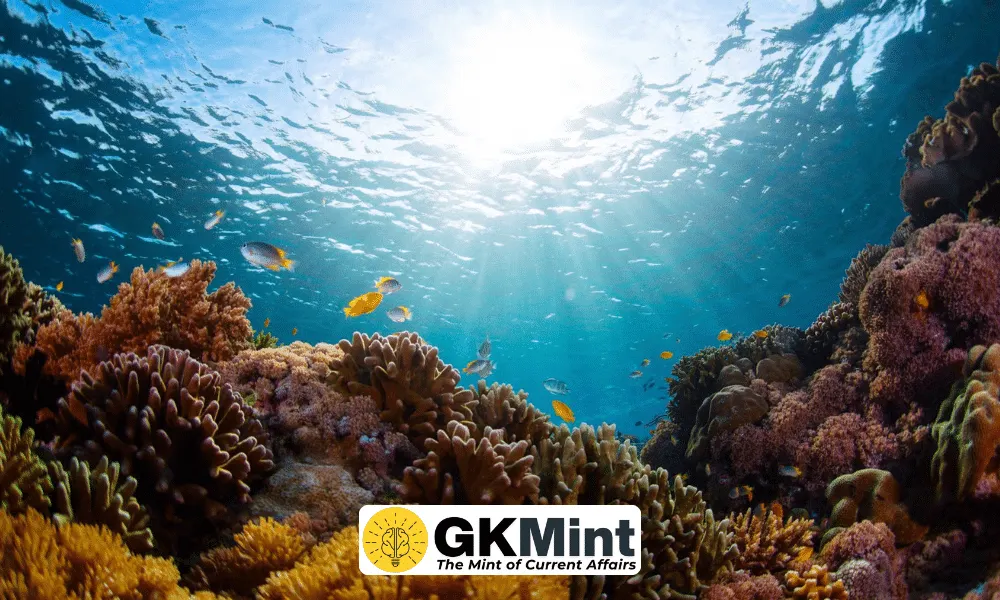
Tamil Nadu Marine Resources Foundation (TNMRF) was launched by the Tamil Nadu Government on September 9, 2025. This foundation aims to protect and restore marine biodiversity, safeguard endangered species, and rehabilitate coral reefs, mangroves, and seagrass ecosystems.
Key Features
- This foundation focuses on expanding protected marine areas.
- Support sustainable livelihoods by training fisherfolk in eco-friendly practices such as aquaculture, seaweed farming, and coastal crafts.
- Promote eco-tourism, environmental education, biodiversity-mapping, and marine GIS research.
Significance
- Marine Biodiversity Conservation: This helps in protecting the endangered species like sea turtles, dugongs, coral-dependent fish, etc. This also helps in restoring degraded ecosystems like seagrass, coral reefs, and mangroves, which are vital feeding and breeding grounds.
- Climate Change Mitigation: Mangroves and Seagrass act as Natural Carbon sinks, Capturing Significant amounts of Carbon dioxide. This also reduces coastal erosion and strengthens natural barriers against cyclones, floods, and rising sea levels.
- Sustainable Livelihoods: This shall provide alternate income sources for the fisherfolk through eco-friendly practices like aquaculture, seaweed cultivation, and handicrafts.
- Promotion of Eco-tourism and Education: May help in encouraging eco-tourism in coastal areas, generating income while raising awareness about marine ecosystems. This also integrates environmental education in schools and communities, increasing the conservation mindset among the youth.
- Community Development and Inclusive Development: This involves the coastal communities directly in the conservation and creating a sense of ownership. They also train fisherfolk and women’s groups, ensuring inclusive development.
Points to Remember
- Tamil Nadu Marine Resources Foundation (TNMRF) was launched by the Tamil Nadu Government on September 9, 2025.
- The foundation aims to protect and restore marine biodiversity and safeguard endangered species.
- It focuses on rehabilitating coral reefs, mangroves, and seagrass ecosystems.
- TNMRF works to expand protected marine areas.
- It supports sustainable livelihoods by training fisherfolk in eco-friendly practices like aquaculture, seaweed farming, and coastal crafts.
- The foundation promotes eco-tourism in coastal areas.
- It encourages environmental education and awareness among schools and communities.
- TNMRF undertakes biodiversity mapping and marine GIS research for better conservation planning.
- It helps conserve endangered species like sea turtles, dugongs, and coral-dependent fish.
- Mangroves and seagrass under TNMRF act as natural carbon sinks, reduce coastal erosion, and protect against cyclones, floods, and rising sea levels.
- The foundation provides alternative income sources for fisherfolk through sustainable practices.
- It involves coastal communities directly in conservation, creating a sense of ownership.
- TNMRF trains women and fisherfolk groups, promoting inclusive development.
- The initiative strengthens climate resilience, community livelihoods, and marine ecosystem protection.
Mains Questions
Paper– 1 (GS – History, Geography, Society, Environment)
- UPSC: Explain the objectives and significance of the Tamil Nadu Marine Resources Foundation (TNMRF). How does it contribute to the conservation of marine biodiversity and sustainable livelihoods along the Tamil Nadu coast?
- TNPSC: Discuss the objectives and significance of TNMRF. How does it help protect marine ecosystems and support coastal communities?
- Focus: Marine biodiversity, coastal geography, ecosystem restoration, social impact.
Paper: 2 (Governance, Polity, Social Justice, IR)
- UPSC: Assess the role of TNMRF in promoting community participation and inclusive development. How can state-led initiatives strengthen governance and policy implementation in environmental management?
- TNPSC: Analyse how TNMRF involves coastal communities and women groups. How does this improve inclusive development and governance?
- Focus: Governance, policy implementation, community engagement, social justice.
Paper– 3 (Technology, Economic Development, Environment, Disaster Management)
- UPSC: Examine the contribution of TNMRF to climate change mitigation, disaster risk reduction, and sustainable livelihoods. Discuss how marine GIS research and eco-tourism can enhance its effectiveness.
- TNPSC: Evaluate how TNMRF can mitigate climate risks and provide sustainable livelihoods. How do eco-tourism and technology aid its objectives?
- Focus: Climate resilience, disaster management, sustainable livelihoods, marine research, and eco-tourism.
Paper 4 (Ethics, Integrity, and Aptitude)
- UPSC: Discuss the ethical dimensions of marine biodiversity conservation under TNMRF. How can policymakers balance the interests of coastal communities, biodiversity, and economic development?
- TNPSC: Explain the ethical and social responsibilities involved in TNMRF initiatives. How should conflicts between development and conservation be addressed?
- Focus: Ethics in policy, equity, integrity in governance, and balancing interests.
Syllabus Correlation
UPSC Prelims
Relevant Syllabus Areas:
- GS Paper 1 – Current Events & Environment
- Ecology and biodiversity (Indian and global)
- Conservation of natural resources
- Environmental pollution and climate change
TNMRF Correlation:
- Conservation of marine biodiversity (coral reefs, mangroves, seagrass)
- Protection of endangered species (sea turtles, dugongs, coral-dependent fish)
- Climate change mitigation through carbon sinks and disaster risk reduction
- Marine GIS research supporting environmental monitoring
UPSC Mains
Paper 1 (GS1 – History, Geography, Society, Environment)
- Geography: Physical geography of India, ecosystems, biodiversity hotspots
- Environment: Biodiversity, conservation strategies, human impact
TNMRF Correlation:
- Marine ecosystems along the Tamil Nadu coast
- Restoration of coral reefs, mangroves, and seagrass
- Impact on local communities and sustainable livelihoods
Paper 2 (GS2 – Governance, Polity, Social Justice, IR)
- Governance: State initiatives, policy implementation
- Social justice: Community participation, women’s empowerment
TNMRF Correlation:
- State-led initiative for marine conservation
- Inclusion of fisherfolk and women in eco-friendly livelihoods
- Policy implementation for sustainable development
Paper 3 (GS3 – Technology, Economic Development, Environment, Disaster Management)
- Environment & Disaster Management: Climate change, natural resources, disaster resilience
- Economic development: Sustainable livelihoods, eco-tourism
TNMRF Correlation:
- Climate resilience through mangroves & seagrass
- Disaster mitigation along coastlines
- Promotion of eco-tourism and marine research
Paper 4 (GS4 – Ethics, Integrity, and Aptitude)
- Ethics in public service, environmental ethics, and decision-making
TNMRF Correlation:
- Ethical balancing of biodiversity conservation and livelihood generation
- Policy integrity and inclusive governance in environmental management
TNPSC Prelims
Relevant Syllabus Areas:
- Environment & Ecology
- Biodiversity and natural resources of Tamil Nadu
- Current events related to state and national environmental initiatives
TNMRF Correlation:
- Conservation of Tamil Nadu’s marine ecosystems
- Coastal biodiversity protection and sustainable livelihoods
- State government schemes for environment and community development
TNPSC Mains
Paper 1 – General Studies 1 (Geography, Environment, Society)
- Physical geography of Tamil Nadu, ecology, and biodiversity
Correlation:
- Marine biodiversity, mangroves, coral reefs, and seagrass restoration
- Impact on local communities and fisheries
Paper 2 – General Studies 2 (Governance & Social Justice)
- Government initiatives, community participation, and inclusive development
Correlation:
- TNMRF as a state policy initiative
- Empowering fisherfolk and women for sustainable livelihoods
Paper 3 – General Studies 3 (Economic Development, Environment, Disaster Management)
- Environmental management, climate change, disaster risk reduction
Correlation:
- Climate resilience along Tamil Nadu’s coastline
- Marine GIS research and eco-tourism for sustainable growth
Paper 4 – General Studies 4 (Ethics & Human Values)
- Ethics in governance, environmental ethics, and social responsibility
Correlation:
- Ethical conservation of marine resources while ensuring livelihoods
- Balancing ecological and social priorities
Quiz
[ays_quiz id=’11’]