
The landscape of rural development in India is poised for a significant legislative overhaul. The newly introduced Viksit Bharat—Guarantee for Rozgar and Ajeevika Mission (Gramin) Bill, 2025, also known by the acronym VB–G RAM G, seeks to repeal the existing Mahatma Gandhi National Rural Employment Guarantee Act (MGNREGA), 2005.
Designed to align with the national vision of Viksit Bharat @2047, this Bill aims to transition from a simple safety net to a framework focused on “empowerment, growth, convergence and saturation”.
Here is a comprehensive breakdown of what this new Bill proposes and how it differs from the previous regime.
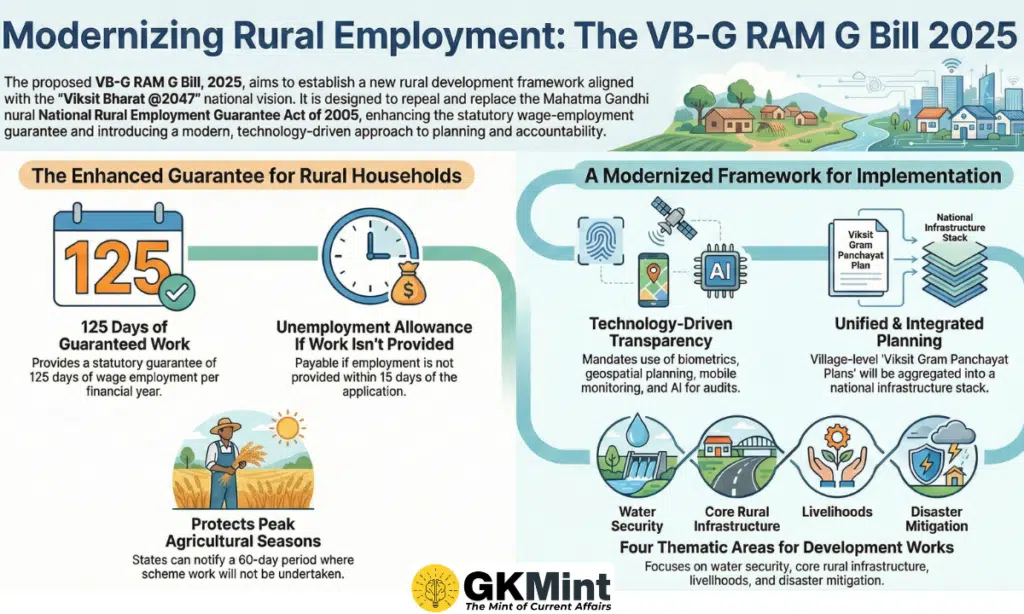
1. Enhanced Employment Guarantee: 125 Days
The headline feature of the Viksit Bharat—Guarantee for Rozgar and Ajeevika Mission (Gramin) Bill, 2025 is the statutory increase in guaranteed work. While the previous act generally assured 100 days, the new legislation guarantees not less than one hundred and twenty-five days of wage employment in a financial year to every rural household whose adult members volunteer for unskilled manual work.
This enhancement aims to enable rural households to participate more effectively in an expanded livelihood security framework.
2. The ‘National Rural Infrastructure Stack’
The Bill moves away from isolated public works towards a highly integrated planning model. It introduces the Viksit Bharat National Rural Infrastructure Stack. This is a consolidated aggregation of works that originate from local Viksit Bharat Gram Panchayat Plans.
These plans must be integrated with the PM Gati Shakti National Master Plan to ensure spatially optimized infrastructure. The works are strictly categorized into four thematic domains:
- Water Security: Including river rejuvenation, recharge pits, and watershed development.
- Core Rural Infrastructure: Such as rural roads, school infrastructure, sanitation, and renewable energy.
- Livelihood-related Infrastructure: Focusing on agri-value chains, storage structures, and livestock shelters.
- Disaster Mitigation: Special works to address extreme weather events like floods and cyclones.
3. Addressing Farm Labor Shortages
A unique and potentially controversial addition is the provision to pause public works during peak farming seasons. To ensure that the employment guarantee does not conflict with agriculture, the Bill mandates that no work shall be commenced during notified peak agricultural seasons.
State Governments must notify a period aggregating to sixty days in a financial year (covering sowing and harvesting) during which Viksit Bharat—Guarantee for Rozgar and Ajeevika Mission works will be suspended to facilitate adequate farm-labor availability.
4. Funding: Normative Allocations and Cost Sharing
The scheme operates as a Centrally Sponsored Scheme. The fund-sharing pattern is distinct:
- 90:10 for North Eastern and Himalayan States.
- 60:40 for all other States with legislatures.
Crucially, the Central Government will determine a “normative allocation” for each State based on objective parameters. If a State incurs expenditure in excess of this normative allocation, the State Government must bear the full burden of that excess cost.
5. Unemployment Allowance
If an applicant is not provided employment within fifteen days of their application, they are entitled to a daily unemployment allowance.
- Rate: Not less than one-fourth of the wage rate for the first 30 days, and one-half for the remaining period.
- Liability: The State Government bears the cost of this allowance.
6. Tech-Enabled Transparency and Accountability
The Bill embeds modern technology into the legal framework to prevent fraud and ensure efficiency. Key measures include:
- Biometric Authentication: Mandatory for workers and functionaries.
- Geospatial Tech: Satellite imagery and geo-referencing for planning and monitoring.
- AI Integration: The use of Artificial Intelligence for planning audits and fraud-risk mitigation.
- Real-time Dashboards: Mobile-based monitoring to track workforce deployment and progress.
7. Governance Structure
The Bill establishes a hierarchical governance structure to oversee implementation:
- Central & State Councils: For monitoring and evaluation.
- Steering Committees: A National Level Steering Committee will recommend normative allocations and oversee convergence.
- Panchayati Raj Institutions: The Gram Panchayat remains the principal authority for planning and execution, responsible for preparing the saturation-based Viksit Bharat Gram Panchayat Plans.
Conclusion
The Viksit Bharat—Guarantee for Rozgar and Ajeevika Mission (Gramin) Bill, 2025 represents a structural shift from “guaranteed employment” to “employment for asset creation.” By increasing the work days to 125, it strengthens the safety net, but by introducing the “normative allocation” cap and the 60-day agricultural pause, it also seeks to impose fiscal discipline and protect the agricultural labor market.
An Analogy to Understand the Shift
Think of the old MGNREGA system as a Generic Spare Tire. It was essential and saved you when you had a flat (unemployment), ensuring you could keep moving, but it wasn’t designed to improve the car’s performance.
The new Viksit Bharat—Guarantee for Rozgar and Ajeevika Mission (Gramin) Bill, 2025 is like upgrading to an Integrated Navigation and Performance System.
- It still acts as a safety net (the 125-day guarantee is the spare tire).
- However, it now connects to a satellite network (PM Gati Shakti/Geospatial tech) to tell you exactly where to drive to build the best roads (Infrastructure Stack).
- It creates a schedule so you don’t fix the car when you need to be driving the harvest truck (60-day agricultural pause).
- Finally, it uses a smart dashboard (AI & Biometrics) to ensure no one else is driving your car on your dime.
It aims to turn a survival mechanism into a growth engine.
Reference: PRS India
Also Read: Supreme Court on Stray Dogs
Frequently Asked Questions (FAQs) on VB-G RAM G Bill:
1. How many days of guaranteed work does a household get under the Viksit Bharat—Guarantee for Rozgar and Ajeevika Mission (Gramin) scheme?
Every rural household whose adult members volunteer to do unskilled manual work is statutorily guaranteed not less than one hundred and twenty-five days of wage employment in a financial year. This is an enhancement from the previous 100-day guarantee provided under the repealed MGNREGA.
2. Can I demand work at any time of the year?
Generally yes, but with a specific exception for farming seasons. To ensure laborers are available for agriculture, the Bill mandates that no work shall be commenced during “peak agricultural seasons”. State Governments must notify a period totaling sixty days in a financial year (covering sowing and harvesting) during which works under this Act will be suspended.
3. What happens if the government fails to provide work after I apply?
If an applicant is not provided employment within fifteen days of their application (or the date work was sought), they are entitled to a daily unemployment allowance paid by the State Government.
- Rate: For the first 30 days, the allowance must be at least one-fourth of the wage rate. For the remaining period, it must be at least one-half of the wage rate.
4. What kind of work will be undertaken under this scheme?
Works are no longer ad-hoc; they must originate from Viksit Bharat Gram Panchayat Plans and form part of the Viksit Bharat National Rural Infrastructure Stack. The works are strictly categorized into four thematic domains:
- Water Security: Rejuvenation of water bodies, recharge pits, and watershed development.
- Core Rural Infrastructure: Rural roads, schools, sanitation complexes, and renewable energy.
- Livelihood-related Infrastructure: Agri-value chains, storage structures, and livestock shelters.
- Disaster Mitigation: Shelters and embankments to handle extreme weather events.
5. How is the scheme funded, and is there a limit on Central funding?
The scheme is a Centrally Sponsored Scheme with a cost-sharing ratio of 90:10 for North Eastern and Himalayan States, and 60:40 for all other States with legislatures. However, the Central Government will fix a “normative allocation” for each State based on objective parameters. Any expenditure incurred by a State in excess of this normative allocation must be borne entirely by the State Government.