
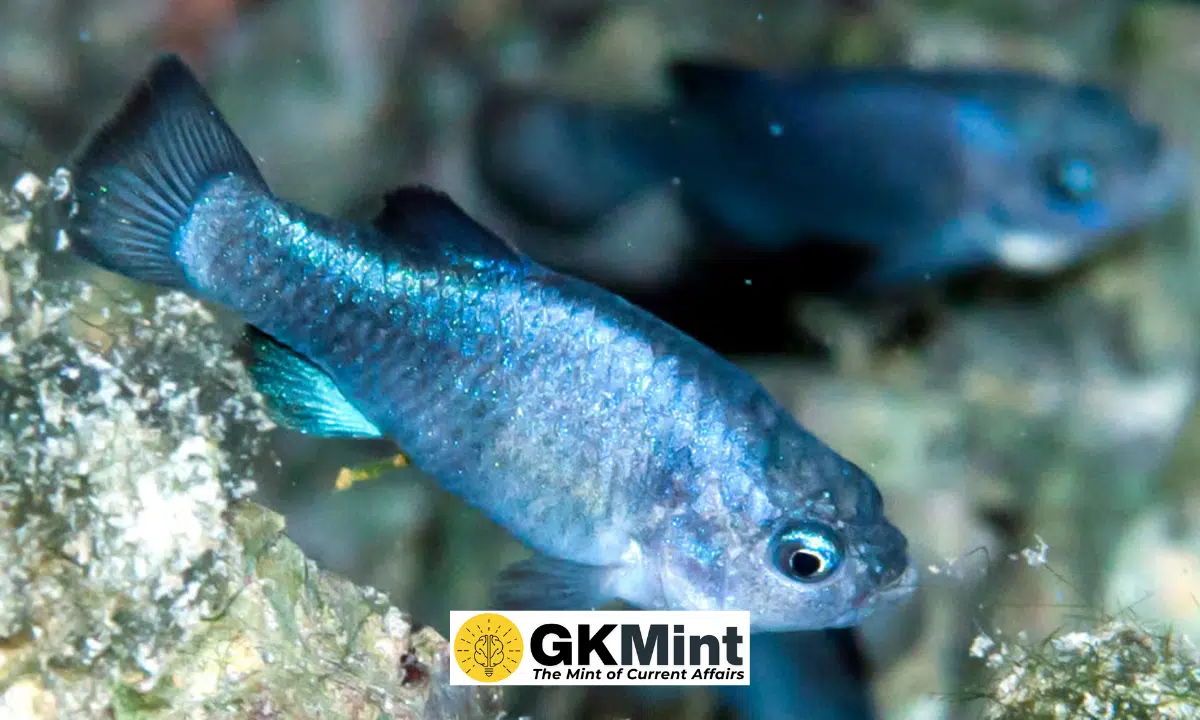
In the vast imagination of wildlife lovers, rare species are often associated with remote rainforests, unexplored oceans, or isolated islands. Very few people would expect one of the most extraordinary vertebrates on Earth to survive in a water-filled crack in the middle of a desert. Yet, hidden within the harsh landscape of the Mojave Desert lies a story of resilience so extreme that it continues to puzzle scientists even today.
Within the boundaries of the Ash Meadows National Wildlife Refuge exists Devil’s Hole, a deep limestone cavern filled with geothermal water. This is the sole natural home of the Surviving Hell: The Story of the rare fish in the world Devil’s Hole pupfish (Cyprinodon diabolis), a species so restricted in range that its entire world is smaller than most living rooms. Its survival is not just improbable—it is almost miraculous.
This fish has become a symbol of endurance against impossible odds, redefining what we understand about evolution, genetics, and conservation biology.
Devil’s Hole: An Environment Hostile to Life
Devil’s Hole is not a typical aquatic habitat. It is a vertical cavern plunging hundreds of feet into the Earth, with only a small opening at the surface. Sunlight barely penetrates the water, and life clings to existence under conditions that would be fatal to most fish species.
The water temperature remains consistently between 33°C and 34°C throughout the year, making it warmer than many tropical seas. Dissolved oxygen levels are extremely low, often approaching thresholds considered uninhabitable for vertebrates. Nutrient availability is minimal, and food sources depend on a fragile balance of algae growth on a single shallow rock shelf.
This narrow limestone shelf, measuring only a few square meters, is the heart of the Rare Fish in the World pupfish’s existence. It is here that feeding, courtship, and spawning all occur. Any disturbance—whether from water level fluctuations, algae overgrowth, or subtle geological shifts—can directly threaten the survival of the entire species.
A Species Living on the Edge of Extinction
The Rare Fish in the World Devil’s Hole pupfish holds the unfortunate distinction of having one of the smallest geographic ranges of any vertebrate on the planet. At times, its total population has dropped below 50 individuals. Such numbers would normally spell immediate extinction.
Yet, year after year, this fish persists.
This persistence has elevated it to global scientific significance. For conservation biologists, it represents the rare fish in the world whose continued existence defies long-held assumptions about population size, genetic diversity, and long-term survival.
Evolutionary Adaptations Beyond Expectation
Metabolic Flexibility in Extreme Conditions
One of the most astonishing traits of the Rare Fish in the World Devil’s Hole pupfish is its ability to survive in low-oxygen conditions. Unlike most fish that depend entirely on aerobic metabolism, this species demonstrates a rare physiological phenomenon known as paradoxical anaerobism.
In simple terms, the fish can temporarily shift to anaerobic energy production—even when oxygen is present. This adaptation allows it to survive sudden drops in oxygen levels, especially during nighttime when algae consume available oxygen. Such metabolic flexibility is almost unheard of among vertebrates and highlights the extraordinary evolutionary pressure exerted by Devil’s Hole.
Surviving Genetic Isolation
Equally remarkable is the fish’s genetic makeup. Due to its tiny population size and extreme isolation, the Rare Fish in the World Devil’s Hole pupfish has experienced severe genetic bottlenecks. Studies reveal that nearly 58% of its genome consists of long runs of homozygosity, making it one of the most genetically inbred vertebrates ever studied.
Conventional evolutionary theory suggests that such low genetic diversity leads inevitably to extinction through inbreeding depression. However, this species challenges that assumption. Despite reduced genetic variation, it continues to reproduce and survive, raising important questions about how much genetic diversity is truly necessary for long-term survival.
This paradox is one reason scientists consider it the rare fish in the world with unparalleled evolutionary importance.
Why the Devil’s Hole Pupfish Matters to Science
Rethinking Extinction Models
The continued survival of this species has forced researchers to reconsider established models of extinction risk. While genetic diversity remains crucial for adaptability, the Rare Fish in the World Devil’s Hole pupfish suggests that in highly stable environments, extreme specialization can offset some genetic limitations.
Its existence demonstrates that extinction is not always a simple equation of population size and genetic variation. Instead, it is shaped by complex interactions between environment, physiology, and evolutionary history.
An Indicator of Groundwater Health
Beyond its scientific curiosity, the pupfish serves as a biological indicator for groundwater ecosystems. Devil’s Hole is connected to a vast underground aquifer system that supports multiple springs across Ash Meadows. Any changes in water level or quality directly impact the pupfish, making it an early warning system for broader ecological disruptions.
Protecting this fish means protecting an entire hidden ecosystem beneath the desert floor.
Conservation Efforts and Human Responsibility
Legal Protection and Habitat Management
The Devil’s Hole pupfish is among the most legally protected fish species in the United States. Court rulings have upheld strict groundwater protections, limiting nearby water extraction to preserve water levels within Devil’s Hole.
Physical interventions, such as removing excess algae and stabilizing the limestone shelf, are carefully conducted under scientific supervision to minimize disturbance.
Captive Breeding Programs
To reduce the risk of total extinction, conservationists have established controlled captive populations that replicate Devil’s Hole conditions as closely as possible. These programs act as genetic insurance, ensuring that the species can be reintroduced if a catastrophic event occurs in its natural habitat.
Such efforts underscore why this species is often described as the rare fish in the world whose survival depends on constant human vigilance.
Lessons for Global Biodiversity Conservation
The story of the Devil’s Hole pupfish extends far beyond a single species. It highlights the fragility of specialized ecosystems and the unintended consequences of human activity, even in places that appear remote and untouched.
Groundwater extraction, climate change, and seismic activity all pose ongoing threats. The pupfish reminds us that biodiversity loss does not always happen in dramatic, visible ways. Sometimes, it occurs quietly, in a crack in the desert, affecting a species few people will ever see.
Protecting such organisms requires not only scientific expertise but also public awareness and long-term commitment.
The Symbolism of Survival Against All Odds
In many ways, the Devil’s Hole pupfish represents hope. Its persistence suggests that life can endure under conditions that seem utterly inhospitable. At the same time, its vulnerability serves as a warning: survival is never guaranteed.
As one of the most studied examples of extreme adaptation, it remains the rare fish in the world that continues to influence conservation strategies, legal frameworks, and our understanding of life itself.
Conservation Resources and Official Information
| Purpose | Link |
|---|---|
| Conservation Notification PDF | https://www.fws.gov/media/devils-hole-pupfish-recovery-plan |
| Apply for Conservation Research Access | https://www.fws.gov/service/apply-permit |
| Official Wildlife Service Website | https://www.fws.gov |
Conclusion
The Devil’s Hole pupfish is more than a biological curiosity. It is a living testament to evolution’s ability to carve survival from impossibility. Confined to a single cavern in the desert, enduring heat, low oxygen, and genetic isolation, it continues to exist where extinction should have prevailed long ago.
Its story challenges scientific assumptions, strengthens conservation policy, and reminds us that every species—no matter how small or obscure—plays a role in the intricate web of life. Preserving such species is not just about saving a fish; it is about protecting knowledge, ecosystems, and the future resilience of our planet.
Also Read: 7 Powerful Ways VB-G RAM G Strengthens Rural Employment Beyond MGNREGA