
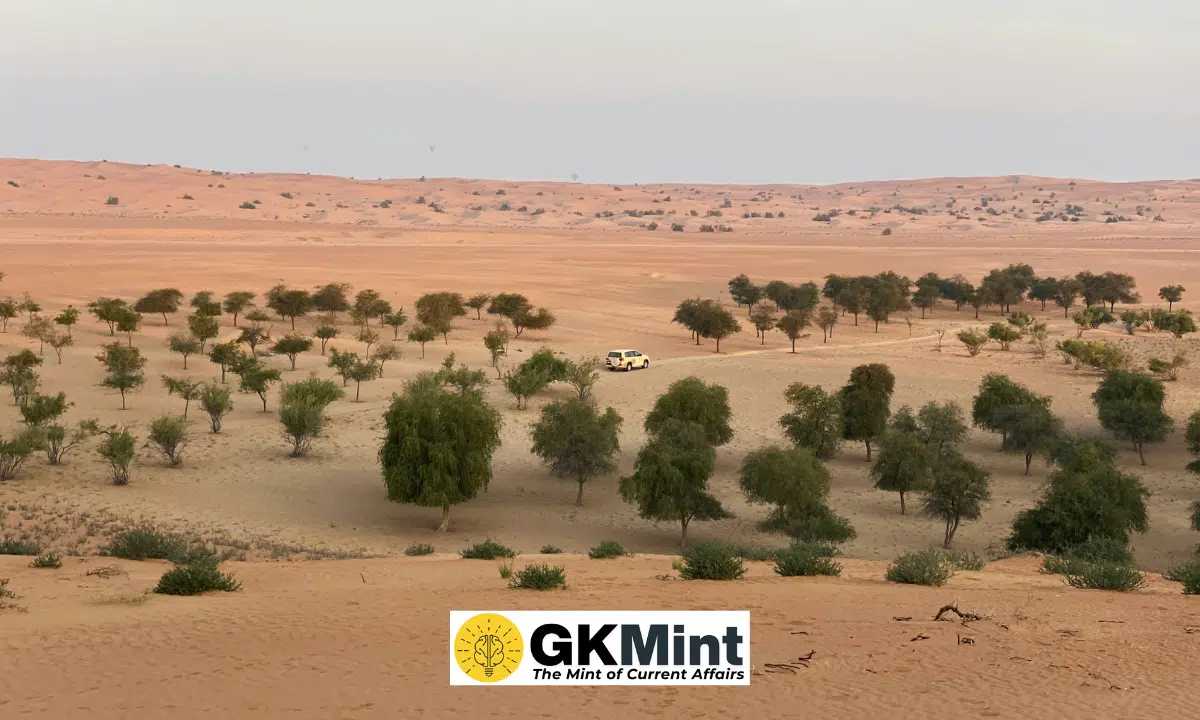
For decades, global imagination has associated Saudi Arabia with endless dunes, scorching heat, and sparse vegetation. The image is not entirely inaccurate. Vast stretches of the Kingdom are dominated by arid and hyper-arid landscapes, including the legendary Rub’ al Khali, the largest continuous sand desert on Earth. Rainfall is minimal, summer temperatures soar above 50°C, and water scarcity defines daily life.
Yet, in a striking departure from conventional expectations, Saudi Arabia has embarked on one of the most ambitious environmental transformations ever attempted in a desert ecosystem. This effort, widely known as Greening the Sands, is not a symbolic gesture or a public-relations exercise—it is a science-driven national strategy aimed at reshaping the country’s ecological and climatic future.
At the heart of this transformation lies a bold commitment: planting 10 billion trees within Saudi Arabia’s borders.
The Saudi Green Initiative: Vision Meets Urgency
Launched in 2021, the Saudi Green Initiative (SGI) is a cornerstone of the Kingdom’s broader development roadmap under Vision 2030. While economic diversification often dominates discussions around Vision 2030, environmental resilience has emerged as an equally critical pillar.
The initiative is part of a wider regional framework known as the Middle East Green Initiative, which aims to plant 50 billion trees across the Middle East. Of this total, Saudi Arabia alone has committed to planting 10 billion—an unprecedented target for a country where natural forests are scarce.
By mid-2025, measurable progress had already been achieved. More than 151 million trees had been planted, and approximately 500,000 hectares of degraded land had been rehabilitated. These figures signal that Greening the Sands is moving beyond planning documents into tangible, on-the-ground action.
Science Over Symbolism: Why Desert Greening Is So Complex
Afforestation in temperate or tropical regions often relies on predictable rainfall, fertile soil, and established ecosystems. Desert greening, by contrast, operates at the edge of ecological feasibility. Without rigorous scientific planning, large-scale planting efforts risk failure, wasted resources, and unintended environmental harm.
Recognizing these risks, Saudi Arabia invested heavily in scientific groundwork before scaling up planting operations.
Extensive Feasibility Studies
Before a single sapling was planted at scale, a comprehensive two-year feasibility study was conducted. This effort involved more than 1,150 field surveys across diverse regions of the Kingdom. Scientists analyzed soil composition, wind erosion patterns, groundwater availability, salinity levels, and temperature extremes.
Rather than importing foreign tree species ill-suited to desert conditions, researchers prioritized native and adaptive plants capable of surviving high water stress. This approach minimizes irrigation demand and reduces the risk of ecological imbalance.
Selecting the Right Species for the Right Place
Different regions require different strategies. Coastal areas, inland plateaus, mountainous zones, and sand deserts each present unique challenges. By matching species selection to microclimates, the initiative improves survival rates while preserving local biodiversity.
This methodical planning distinguishes Greening the Sands from earlier desert greening attempts around the world that failed due to oversimplified assumptions about ecosystems.
Water Innovation: The Backbone of the Project
Tree planting on this scale would be impossible without addressing the fundamental constraint of water scarcity. Saudi Arabia has approached this challenge through technological innovation rather than reliance on natural rainfall alone.
Global Leadership in Desalination
Saudi Arabia is currently the world’s largest producer of desalinated water, with a daily capacity of approximately 16.6 million cubic meters. While desalinated water is primarily used for domestic and industrial purposes, it indirectly supports environmental projects by reducing pressure on natural aquifers.
Treated Wastewater Reuse
Another critical pillar is wastewater recycling. Around 32% of treated wastewater in Saudi Arabia is now reused, including for irrigation and land rehabilitation projects. This circular approach ensures that tree planting does not compete with drinking water needs.
Cloud Seeding Experiments
To complement ground-based water strategies, Saudi Arabia has also invested in cloud seeding technology. Recent trials reportedly generated approximately 6.4 million cubic meters of rainfall. While cloud seeding is not a standalone solution, it plays a supportive role in enhancing local precipitation under specific atmospheric conditions.
Together, these innovations provide the hydrological foundation that makes Greening the Sands feasible rather than aspirational.
Environmental and Climate Objectives Beyond Trees
Although tree planting captures public attention, the broader goals of the initiative extend far beyond visual greening.
Land Restoration at Scale
One of the primary objectives is restoring 3.8 million hectares of degraded land. Healthy soils improve water retention, reduce dust storms, and support native wildlife. In a region prone to desertification, land restoration enhances both ecological and human resilience.
Climate Mitigation and Carbon Strategy
Saudi Arabia has committed to achieving net-zero greenhouse gas emissions by 2060 through a framework known as the “Circular Carbon Economy.” This approach emphasizes reducing emissions, reusing carbon, recycling waste, and removing carbon through natural and technological means.
Trees play a critical role in this model by acting as carbon sinks. However, the emphasis remains on systemic emissions reduction rather than offsetting alone—a key distinction in credible climate policy.
Renewable Energy Integration
Environmental reform is closely linked to energy transition. The Kingdom aims to generate 50% of its electricity from renewable sources by 2030. Solar and wind projects across the country complement land-based environmental initiatives, reinforcing a holistic sustainability strategy.
Regional and Global Significance
The implications of Greening the Sands extend beyond national borders. The Middle East is among the regions most vulnerable to climate change, facing rising temperatures, water scarcity, and increased frequency of extreme weather events.
By investing in large-scale ecological restoration, Saudi Arabia positions itself as a regional leader in climate adaptation. The knowledge generated—from desert forestry techniques to water-efficient irrigation—has the potential to inform similar efforts across arid regions worldwide.
Moreover, success in such a challenging environment challenges the assumption that deserts are ecologically static and beyond restoration.
Challenges and Criticisms
Despite its ambition, the initiative has not been free from scrutiny. Critics question long-term tree survival rates, water sustainability, and ecological impacts. Others caution that afforestation must not distract from reducing fossil fuel emissions.
These concerns are valid and underscore the importance of transparency, adaptive management, and independent scientific monitoring. Saudi authorities have emphasized that the project will evolve based on data, not political timelines.
Greening the Sands is therefore best understood as a long-term experiment—one that accepts uncertainty while striving for measurable progress.
Why This Initiative Matters
At its core, Greening the Sands represents a shift in how nations confront climate constraints. Instead of viewing geography as destiny, Saudi Arabia is attempting to reshape its environmental narrative through technology, science, and policy integration.
The initiative acknowledges that environmental transformation in extreme conditions is neither quick nor simple. Yet, it asserts that inaction is no longer an option.
If successful, this effort could redefine what is possible for arid and semi-arid regions facing climate stress in the decades ahead.
Key Resources and Official Information
| Purpose | Link |
|---|---|
| Official Initiative Report (PDF) | https://www.greeninitiatives.gov.sa/en/sgi |
| Apply for Environmental Projects & Research | https://www.mewa.gov.sa |
| Official Saudi Green Initiative Website | https://www.greeninitiatives.gov.sa |
Conclusion
Transforming a desert is among the most complex environmental challenges humanity can undertake. Saudi Arabia’s approach combines ecological caution with technological ambition, recognizing that sustainable change requires patience, data, and innovation.
Greening the Sands is not simply about planting trees; it is about restoring land, stabilizing climate systems, and rethinking how development and ecology coexist in extreme environments. Whether the initiative ultimately achieves all its targets remains to be seen, but its scale and seriousness have already altered the global conversation around desert sustainability.
In a warming world where arid regions are expanding, the lessons emerging from this project may prove invaluable—not only for the Middle East, but for the planet as a whole.
Also Read: Rare Fish in the World